Follow us
 Connect with us
 Pinterest
 Writers' videos
 Instagram
 vicarsfaq.co.uk
Malcolm Johnson on Ape, Spy, Jehu Junior, and their memorable portraits of leaders of Church and State …
Thomas Gibson Bowles, the editor/owner, founded Vanity Fair in 1868 but it received little attention until he decided to include a weekly caricature in the magazine, the first of which was Benjamin Disraeli. This immediately increased the financial wellbeing of the Bowles’ new venture and circulation soared to over 2,500. This momentous decision to introduce ‘some Pictorial Wares of an entirely novel character’ meant that 2,362 cartoons appeared between 1868 and 1914.
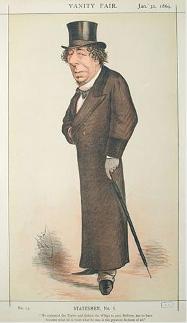
Disraeli (pictured) was drawn by Carlo Pellegrini, ‘Ape’, aged 25, who had arrived in London in November 1864 and been taken up by the Prince of Wales and his set who commissioned him to sketch them. Bowles soon realised that Pellegrini’s ability to ‘charge and exaggerate such lines and tones as exist already’ in the faces and figures of his famous victims, was just what was needed.
Leslie Ward, ‘Spy’, a youth of 22, was introduced to Bowles by Millais in 1873 and he would go on to produce over 1,300 cartoons for the magazine. He relished his position as a sketcher of Society and was probably too sympathetic to his subjects. However, today he is still famous and all Vanity Fair caricatures are often known as ‘Spy cartoons’.
Every caricature was then followed on the next page by a biographical commentary written by Bowles himself, under the pseudonym ‘Jehu Junior’. Often they were polished, witty and as amusing as the cartoon. Bowles had no staff only contributors, who remained anonymous and sent their comments to his smart office in St James’s Street. There were no boozy, weekly lunches.
Private Eye’s ‘Bishop of the Month’ caused much merriment in the 1990s. They were often scandalous, incisive and revealing. I was, however, told that some bishops were very offended that they were not featured. The same happened in Vanity Fair because Bowles excluded those he disliked, including one Charles Dickens.
Each week the magazine treated its readers to a lively and often libellous burlesque on contemporary political ‘vanities’ and the shape of its contents remained much the same. Its size and format - eight to twelve folio pages including advertisements, a commentary on the week’s political and social events, reviews, features on finance, the church and law – were popular from the start. Its tone was ‘light, epigrammatic, pungent and excessively neat’. The adverts, for wines, cheeses, cigars, ladies’ dresses and gloves, pain remedies and resort hotels reveal that the readership was middle and upper class. Society news and gossip rubbed shoulders with Parliamentary debates and regular features such as word games and book reviews.
Many of the aforementioned write-ups are no longer accessible to the general reader, and the original drawings are very difficult to find indeed. However, prints of the cartoons are available today for sums varying from £15 to £300.
In 1884 Bowles became proprietor of a new journal, The Lady, which still exists. His interest in Vanity Fair waned and in March 1899 he sold it to Arthur Evans for £20,000, (around £2.1 million in 2014 money). In 1914 the magazine was absorbed by Hearth and Home.
50 of these caricatures with commentaries make up my book Victorian Worthies, and as they show, Bowles could be kind – or caustic. Henry Villiers, Vicar of St Paul Knightsbridge in 1902 was described as:
‘Not very beautiful to look at, but there is no better persuader of money out of ladies’ pockets. He is a splendid beggar.’
Harvey Goodwin, Bishop of Carlisle:
‘… exemplifies the truth that earnestly delivered platitudes often obtain weight and command attention. He is an excellent, undistinguished, second class Bishop.’
Ryle, the evangelical Bishop of Liverpool is:
‘… a great favourite with women; he is fond of exercise, fresh air and matrimony, and has been married three times. He is a good man, not at all large-minded, but very much in earnest.’
Bishop Colenso of Natal:
‘was called by many hard names and since it was found that he could not be refuted, it was resolved that he should be prayed for in the next world and ruined in this.’
Where would Ward and Bowles find their ecclesiastics in today’s dull and drab Church of England? Rowan Williams, Richard Chartres and John Sentamu would make splendid caricatures and are obvious choices, as are Donald Reeves, Roger Royle (the secretary of whose fan club lives at the end of the Mall), and former Communard Richard Coles. Michael Marshall is a latter-day Edward King. Deans are a dreary lot but Victor Stock formerly of Guildford and June Osborne of Salisbury would be suitable - provided she brings her young Bishop with her. Famous, holy laity are hard to find, but Ian Hislop, A. N. Wilson and Roy Strong (provided he wears his Abbey outfit) are candidates. But Who else?
Something, perhaps, to ponder over tea, or with a glass of wine at dinner.
Victorian Worthies: Vanity Fear’s Leaders of Church and State by Malcolm Johnson is out now in hardback and eBook, available from www.dltbooks.com.